Je suis Charlie….

Embed from Getty Images

The recent attack on the Paris offices of Charlie Hebdo, a French magazine known for its cutting political satire, by militant jihadists on January 7, 2015 leaving a dozen dead and another dozen wounded has underscored the need for all those who value freedom of speech, freedom of the press and freedom of thought, conscience and opinion to stand up and be counted.
Continue reading

The PM names a new Supreme Court of Canada justice – but ignores his own protocols

Suzanne Cote

Photo of Future SCC Justice Suzanne Cote from Osler, Hoskin & Harcourt website

Prime Minister Harper announced late last week that his choice for replacing soon to retire Justice Louis LeBel was Suzanne Cote, a respected member of the Quebec bar and commercial litigator with the esteemed law firm of Osler, Hoskin & Harcourt. While his choice of judge cannot be faulted, the manner in which he is carrying out this nomination can be.

Continue reading

David Suzuki and the plea for a constitutional right to a healthy environment

Embed from Getty Images

Dr. David Suzuki, that famous Canadian scientist who has used the media to advance his arguments for the protection of the environment, is up to it again. As part of his recently concluded “Blue Dot Tour”, he has pressed for the amendment of the Canadian Charter of Rights and Freedoms to include a “right to a healthy environment” (Newfoundland & Labradaor, TheIndependent.Ca, September 24, 2014). He states that virtually all Canadians would support such an objective.

While I agree with Dr. Suzuki’s overall objectives, I think other types of constitutional reforms may be more effective in achieving the ultimate goal of a clean and healthy environment.

Continue reading

The iRevolution revisited: when you share, are you expressing?

speakers corner

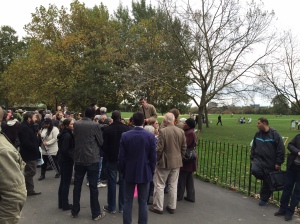
Speakers’ Corner, London, United Kingdom, October 25, 2014 (taken by Arthur Grant)

For over 150 years, people have come to Speakers’ Corner in Hyde Park, London, for the debates. Some come to speak. Others come to heckle. And others just listen and observe. A couple of weeks ago, I ended walking to Speakers’ Corner and listening with great interest to the “debates”. Some of the debates were about religious issues. Some were about immigration. Others seemed to be about nothing at all. It was fascinating to watch this all unfold, this fundamental exercise of freedom of expression.  As important as the speakers are the hecklers – described by one of the placards to the Corner as “essential to the dynamics of Speakers’ Corner”. I would also argue that equally important were the observers – those who stood and watched much like me, not saying anything but listening to the cut and thrust of the debates and simply taking in the mood of the crowds.

Speakers’ Corner is an important manifestation of the exercise of free speech. Its origins date to the mid-19th century – some date it even earlier than that. It is a reflection of a time when oral debates – heard and seen by many people – were a means of addressing matters of public interest. The world has changed dramatically since then.

We now live in a world bound together by radio-communications, by cell phones, televisions, mobile devices, satellite signals and, most prominently, by the Internet. The world has become a much smaller place. We communicate with each other around the world using Skype and FaceTime. We text and email and tweet and exchange documents and photos and videos nearly instantaneously.  The global village exists now.

Part of that global village involves file-sharing. In earlier posts, I spoke about the importance of the iRevolution to society in general and the dawning realization of the judiciary of the importance of the Internet: “The Internet Turns 25 Years Old – the Court and the World Wide Web”. In this post, I want to underscore the fact that by sharing files, whether they be audio-files, video-files, text-files, or software files, we are engaging in the extension of what is Speakers’ Corner. We are engaged in a human exercise of freedom of expression, freedom of speech.

Continue reading

A constitutional home for the homeless – the Oppenheimer Park decision misses the mark

Madam Justice Duncan of the Supreme Court of British Columbia was recently faced with a difficult decision – to evict scores of homeless who had occupied Oppenheimer Park in Vancouver’s Downtown Eastside or to let them stay in their informal tent city. The City’s Park Board bylaws prohibited any one to stay in a park after its posted hours and prohibited the erection of tents without permission of the City. Moreover, the bylaws prohibited what one might term disorderly conduct. The posted hours for Oppenheimer Park were from 6:00 am to 10:00 pm. In other words, the park was closed from 10:00 pm to 6:00 am. While I will not suggest that, in the end, Justice Duncan came to the wrong result (Vancouver Board of Parks and Recreation v. Williams, 2014 BCSC 1926), I will argue that she missed an extremely important element of the whole purpose of the tent city.

Continue reading

O Canada! Standing on guard for thee….

Embed from Getty Images

It is with heavy hearts that Canadians throughout the land close out this day. Today Cpl. Nathan Cirillo lost his life while serving as an honour guard at the War Memorial in Ottawa. A gunman shot Cpl. Cirillo in cold blood for motives that remain unclear. The gunman then moved to Parliament’s Center Block where a gunfight ensued and the gunman was killed. Canadians grieve for Cpl. Cirillo and for his family. They are deeply grateful for the courage and valour of the security forces who defended Parliament, its members, staff and visitors, putting their lives on the line. “Thank you” “merci” to them all.

Continue reading

A stunning victory for access to justice: Trial Lawyers Association v. British Columbia

Embed from Getty Images

The constitutional principle respecting access to justice was given a major shot in the arm today. In what I consider to be a stunning decision, the Supreme Court of Canada has given real force and effect to this unwritten constitutional principle and ruled that British Columbia’s civil hearing fee regulations are unconstitutional. The Court is increasingly aware, it would seem. that the unwritten constitution may be as important and sometimes more important than the written one. The decision of Trial Lawyers Association et al v. British Columbia, 2014 SCC 59 is a game changer.

Continue reading

Today’s vote in Scotland is a reminder for Canada – we have work to do

Today, the people of Scotland are voting in a referendum to decide whether or not Scotland should be an independent country. Canadians have experienced this twice before – once in 1980 and another time in 1995. The parallels between the 1995 Quebec vote and today’s referendum are uncanny: in both cases, the “No” campaign was expected to win. In both cases, the “No” campaign was left to a less than inspiring leadership. In both cases, near the end of the referendum, there was a surge of popular support for the “Yes” campaign. In both cases, the leadership at the national level severely underestimated the potential for the “Yes” vote. And in both cases, there were last minute desperate rallies on the part of the “No” campaigners, with national prime ministers and national opposition leaders alike coming together to plead for the future of the greater country. Whether the 11th hour pleas will succeed in moving enough Scots over to the “No” side we do not know. We will find out tomorrow.

Continue reading

Constitutional Expertise in Parliament – an Unused Resource?

As of the date of this post, Canada’s Parliament boasts three sitting members who are all experts in constitutional law. I do not know if we have ever had such a bounty of constitutional know-how in the House of Commons. But what is interesting to me is that our elected chamber has available to it some of the most eminent constitutional scholars that the country can offer at a time when the government consistently enacts or seeks to enact unconstitutional legislation. Part of the problem may be that one of the three sits as members of the Official Opposition (the New Democratic Party) and the other two sit as members of the Third Party (the Liberal Party of Canada).

Regrettably, it would appear that Parliament increasingly fails to pull upon the background and experience of its members and instead prefers to inhabit partisan space. In my opinion, if our legislative bodies drew upon and respected the knowledge of their members, our democracy would be much healthier and more balanced than it is now. Imagine how different things might be if the constitutional opinions of these members were sought and debated in Parliament.

So here are the three members, in alphabetical order of their last names, with photos either from the Parliament of Canada’s website or from their respective party’s website and information taken from their individual sites. (If I have missed any other constitutional lawyers sitting in Parliament, I apologize in advance).

Continue reading

“I forgot” – no excuse for infringing an accused’s right to counsel

Embed from Getty Images

An innocent omission, a slip of the mind, an honest mistake of an arresting police officer is not sufficient to prevent the Court from excluding evidence obtained following a violation of an accused person’s right to counsel. Last Friday, the Supreme Court of Canada reinforced that right and determined that, notwithstanding the inadvertent nature of the police’s behaviour, the correct remedy was to exclude the evidence subsequently obtained.

Continue reading