On October 19, 2015, Canada goes to the polls. The hurly burly of the Canadian version of democracy has been on display since early August when Prime Minister Stephen Harper asked the Governor General to dissolve Parliament and to call this election. What many of us do not appreciate is that this spectacle is probably one of the best examples of our constitution at work.
Section 28 of the Charter – the forgotten provision – putting feminism back into gender equality
This last week, lawyer and Ph.D. candidate and Vanier and Trudeau scholar, Kerri Froc, was interviewed by Jim Brown on the CBC program, The 180, about gender equality and the rationale behind s. 28 of the Charter. Section 28 states:
Rights guaranteed equally to both sexes
28. Notwithstanding anything in this Charter, the rights and freedoms referred to in it are guaranteed equally to male and female persons.
Ms. Froc’s interview can be found at The 180 website and is well worth listening to.
The niqab can stay – Canada (Citizenship and Immigration) v. Ishaq, 2015 FCA 194
On September 15, 2015, the Federal Court of Appeal issued a short ruling from the bench in the appeal of Zunera Ishaq’s case respecting the Department of Citizenship and Immigration’s policy that requires women who wear a niqab to unveil in order to take the oath of citizenship. In Canada (Citizenship and Immigration) v. Ishaq, 2015 FCA 194, Madam Justice Mary Gleason rendered a short six paragraph oral set of reasons, issued in this manner so that Ms. Ishaq might still be able to take the oath of citizenship and vote in the upcoming election.
Continue reading
The Governor General – will he be playing a bigger constitutional role after October 19th?
It is almost exactly one month to Election Day in Canada and the party leaders have been making all sorts of statements with a view to garnering sufficient votes to form the next government. Some of their statements, however, have had constitutional implications. In today’s Globe & Mail, Professor Eric Adams of University of Alberta has presented a quick summary of the leaders’ misconceptions as to who gets to form a government in the event there is no one party with a majority in the House of Commons. His article, “Minority Governments: The constitutional rules of the game” outlines how Conservative leader Stephen Harper, NDP leader Tom Mulcair and Liberal leader Justin Trudeau all get it wrong when it comes time to articulating the rules for formation of government.
Strata Corporations are not “government” for the purposes of the Charter
A recent decision on the Supreme Court of British Columbia has dismissed a strata property owner’s constitutional challenges to certain provisions of the Strata Property Act. In The Owners, Strata Plan NW 499 v. Louis, 2015 BCSC 1487, Mr. Justice Armstrong held that, although creatures of statute, strata corporations were not “government” for the purposes of the Charter and therefore, the disgruntled Mr. Louis’ constitutional arguments were not supportable
Continue reading
A new way of appointing SCC justices? Process be damned….
On July 27, 2015, Prime Minister Stephen Harper named Mr. Justice Russell Brown of the Alberta Court of Appeal to the Supreme Court of Canada. Justice Brown has been a judge for two and a half years. I am not going to comment on whether Justice Brown is or is not a good appointment. His track record as a judge is too short to be able to honestly answer that question. Only time will tell. But I am going to comment on the process, or more properly speaking – the lack of process, that the Prime Minister is following.
The PM puts a moratorium on Senate appointments
This week, Prime Minister Stephen Harper announced that there would be no further Senate appointments on his watch – either the Senate will be abolished or there will have to be substantial reforms to the Senate before he alters this position. The Prime Minister says that it is up to the provinces to come up with a solution. This is apparently part of his election platform. The question has to be posed: is the Prime Minister acting unconstitutionally?
Continue reading
The British Columbia Court of Appeal puts the brakes on freedom of association – BCTF v. BC, 2015 BCCA 184
After the Supreme Court of Canada made a number of decisions enlarging the scope of the fundamental freedom of association in the field of labour relations, in British Columbia Teachers Federation v. British Columbia, 2015 BCCA 184, the British Columbia Court of Appeal has slowed its growth and given some considered discussion of the Supreme Court’s recent pronouncements in the field. A majority of four of a five member panel led by Chief Justice Bauman and Mr. Justice Harris reviewed the law respecting freedom of association, including the recent decisions of the Supreme Court in Mounted Police Association of Ontario v. Canada (Attorney General), 2015 SCC 1 (“MPAO“)and Saskatchewan Federation of Labour v. Saskatchewan, 2015 SCC 4 (“SFL“). Their comments provide penetrating insights as to one approach to understand the newly reconstructed freedom of association.
Secularism and the Canadian State – Where do we go from here? Mouvement Laique Quebecois v. Saguenay (City), 2015 SCC 16
The Supreme Court of Canada recently pronounced on the appropriateness of a municipal council insisting on a prayer before holding its meetings. In Mouvement Laique Quebecois v. Saguenuay (City), 2015 SCC 16, Justice Gascon for the majority (Abella J dissenting on the question of the variable test for judicial review of administrative tribunals) held that City of Saguenay’s bylaw which provided for the use of such a prayer, even if it did not derive from any particular denomination, nonetheless offended the freedom of religion of atheists and agnostics (the freedom not to believe) and was therefore inoperative.
Un de nos disparus: Ted McWhinney, QC – May 19, 1924 – May 19, 2015. The passing of a renowned Canadian constitutional scholar
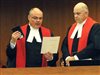
Edward McWhinney, Q.C.
On May 19, 2015, Canada lost one of her great constitutional scholars. Edward (“Ted”) McWhinney, Queen’s Counsel, former Liberal Member of Parliament for Vancouver Quadra, and constitutional and international law expert passed away on his 91st birthday. Ted McWhinney was born in New South Wales, and then educated first in Australia and later at Yale where he obtained his doctorate in constitutional and international law. Along the way, Canada became the lucky beneficiary of this citizen of the world who made Canada his home and eventually his nationality. He was fluent in English, French, German and Russian, and authored 24 books, three of which were in French or German, and countless papers of distinction. He was the first Canadian to be elected to the Institut du droit international based in Geneva and was actually that Institut’s president from 1999-2001. He ended his career as a university professor as a professor emeritus with Simon Fraser University. His full obituary was published in the Province. Thank you, Ted McWhinney, for your contributions to Canada and to the world. We are all richer because of your brilliance and your life’s work.
I remain
Constitutionally yours
Arthur Grant

![mcwhinney[1]](https://constitutionalcanadian.com/wp-content/uploads/2015/05/mcwhinney1.jpg?w=560)